A craft measured in generations
Furniture made at the scale of everyday life
A somokjang (小木匠) makes the doors, windows, chests, desks, and cabinets that give life to an interior. Unlike a daemokjang (大木匠), who raises a building, the somokjang works at the intimate scale of the things we touch and live beside.
Korean wooden furniture was never merely an object placed inside a house. It organized daily rituals, protected clothing and documents, and carried wishes for the family who lived with it.
Jeonjujang emerged from conditions particular to Jeonju. As the administrative center of Jeolla Province during the Joseon period, the city drew government workshops and skilled craftspeople. Officials and affluent households created a steady demand for furniture, while fine timber such as zelkova and black-patterned persimmon was readily available nearby. These social, economic, and material conditions allowed furniture making to flourish, giving rise to Jeonjujang as one of the region’s distinctive storage cabinets.
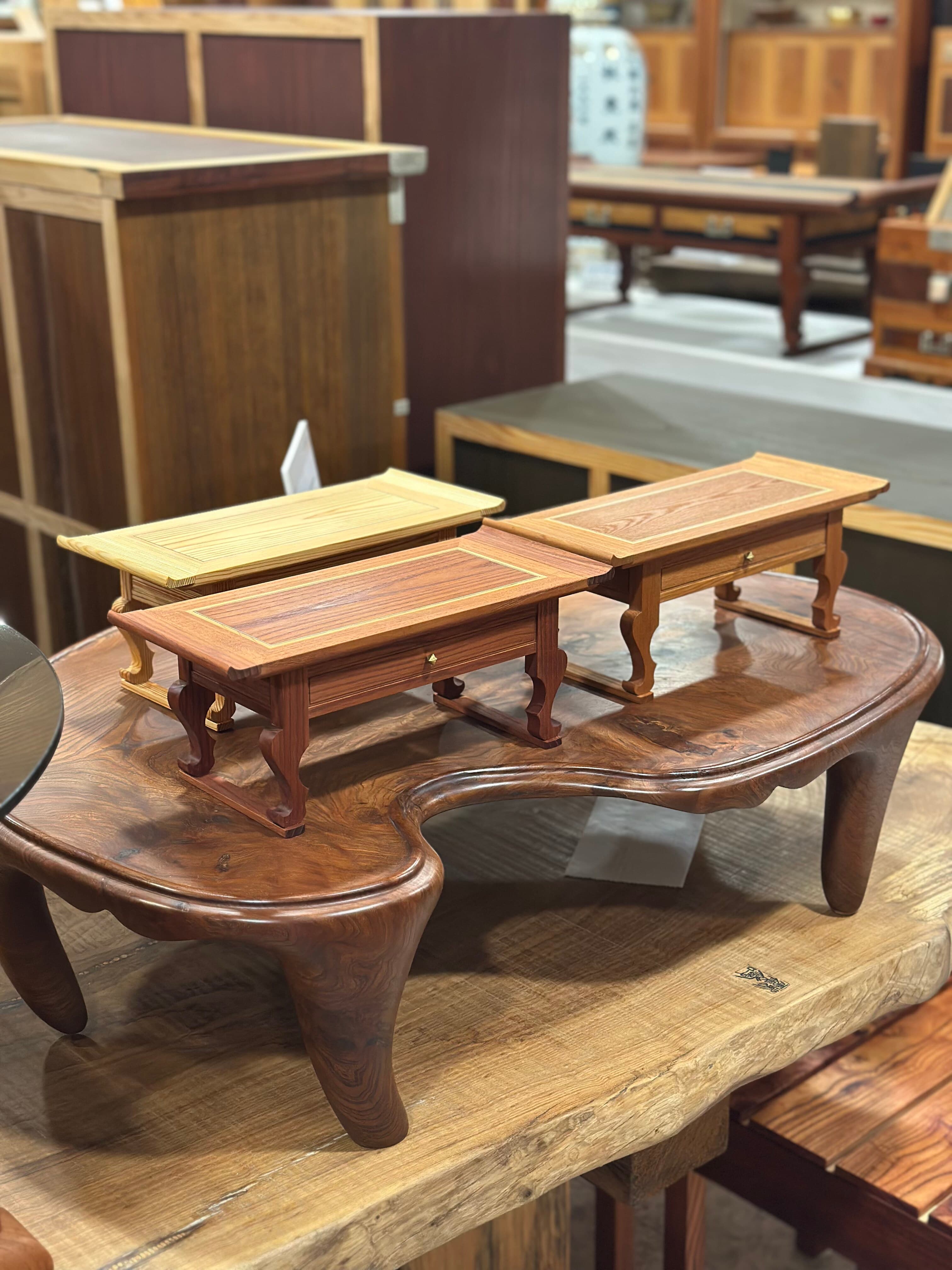
Works by So Joonghan, an isuja and certified practitioner of the National Intangible Heritage of Somokjang
01 · Waiting
The years before the first cut
In the Wanju workshop’s warehouse, the making of furniture begins with wood that appears to be doing nothing. In truth, it is performing one of the longest tasks of all: releasing the water held deep inside its cells. Wood that is shaped too soon will shrink, twist, or split later. So the boards wait, sometimes for decades.
So Joonghan explained that machines can hasten the drying, but naturally dried wood feels different when he works with it. Here, air and seasons are allowed to do the work. A tree must sprout, grow, fall, and then spend still more years exhaling before a cabinet can begin. Seen this way, the timber in the shed did not feel dead. It felt as if each tree were slowly laying down everything it once held so that it might be useful again.
Natural drying is therefore not simply preparation. It is the first act of making: a long negotiation between material, climate, and judgment. The artisan cannot order the wood to become ready. He can only stack it carefully, keep air moving around it, and learn when it has released enough of its former life to accept a new one.
A fallen tree can be given another life, one in which it is touched, kept, and cared for.
That belief is why the workshop is sometimes called when an old village tree comes down. People hope that, in the hands of a somokjang, a familiar tree may return to the community in another form. Among the stacked boards we saw rare landscapes that only time could draw: the ink-wash darkness of meokgamnamu, old persimmon heartwood, and yongmok, a rare natural figure distinguished by swirling or rippling patterns formed within the wood.
Neither pattern can be designed in advance. The black heart of the persimmon and the distinctive forms of yongmok are records of circumstances endured by the tree. What might once have been read as irregularity becomes, in furniture, the point around which the entire composition is built. The somokjang does not cover nature’s accidents. He gives them a place to be seen.
Timber storage at So Byeong-jin’s workshop and training space, where boards are naturally dried and kept for future furniture.
Meokgamnamu, old persimmon heartwood marked by ink-like black patterns.
Yongmok, a rare natural figure distinguished by swirling or rippling patterns formed within the wood.
02 · Revival
A cabinet returned to Jeonju
Somokjang was designated in 1975 and is now recognized as a National Intangible Heritage of Korea. It preserves the knowledge required to make wooden furniture that can endure while the living material continues to move.
Developed in and around Jeonju during the Joseon period, the Jeonjujang is admired for more than fine timber and balanced proportion. Its metalwork carries wishes into daily life. Bat-shaped fittings represent good fortune, while small octopus-like iron motifs express hopes that a family will flourish through many generations. A hinge or clasp is therefore never only hardware. It makes the family’s hopes visible on the face of an everyday cabinet.
Master artisan So Byeong-jin revived the tradition of Jeonjujang after its lineage had been broken.
Recognized as a National Intangible Heritage holder in 2014, So Byeong-jin has continued not only through his own work but through teaching. His workshop and training space in Wanju feels like the physical record of that commitment: completed furniture stands among walls of planes, chisels, saws, gauges, and mallets, while new pieces continue to emerge from the same benches. Here, knowledge is stored not only in drawings or written records, but in pressure, sound, proportion, and repeated movement from one pair of hands to the next.
Here, preservation is not the act of keeping an object still. It is the act of making again.
Inside the living workshop
A closer look · Doors without ordinary hinges
A door that reveals how the cabinet thinks
So Joonghan Instagram ↗ showed us doors whose movement would be easy to miss in a still photograph. They went beyond the familiar choices of a sliding panel or a hinged door opened by a handle. Some first had to be lifted or shifted before opening. Others separated from the cabinet altogether. The door and frame had been shaped so that the panels could be released and fitted back into place in unexpected ways.
The movements initially feel like puzzles. Yet once the hidden order becomes visible, each action appears precise and inevitable. The door does not simply hang from the cabinet. It belongs to a larger wooden structure in which every component has been considered in relation to the others. The three short films below record these unusual opening methods. The knowledge becomes much clearer through movement than through description.
In the first film, So describes a sachulmun, a structure in which all four panels can be removed. In this particular angojigi arrangement, the outer panels appear to embrace the inner ones. Sliding and swinging movements are combined: a panel must be pushed, shifted, and opened in the correct order before it can come free.
The second film shows a door that moves within wooden grooves rather than depending on metal hinges. So explains that the wood around a fixed hinge can split as it contracts and expands. This panel is not fixed to a hinge and can move within its wooden grooves, reducing that risk.
In the third film, two wooden projections follow two corresponding grooves. The panel cannot be removed at just any point. It comes free only when it reaches the one position where the projections and openings align. The same logic is repeated across all six panels, allowing the entire front to be opened when needed. These are not recent inventions, So notes, but opening methods found in furniture from the Joseon period.
03 · Continuance
Tradition, made for the room we live in now
So Joonghan, So Byeong-jin’s son and an isuja, a certified practitioner of the National Intangible Heritage of Somokjang, is asking a difficult question: how can traditional furniture remain itself while belonging naturally in the rooms we inhabit now? His answer is not to copy an old cabinet at a reduced scale, nor to strip away every historical detail. It is to decide which qualities carry the tradition’s intelligence forward.
Some of his pieces are smaller, responding to contemporary homes. Hardware is reduced so the grain and proportion can speak more quietly. Yet the old logic remains. A door may open by a method now rarely seen, and the cabinet may be held together without nails. Wood is joined to wood, and structure becomes ornament. Modernity appears here not as a rejection of inheritance, but as careful editing.
He explained that wood, because it is natural, will always move a little as time and humidity change. A metal nail fixes one point rigidly and can eventually bruise or split the fibers around it. Traditional joinery allows the parts to answer those changes together. If the wood shifts, the structure shifts with it. This is wisdom our ancestors arrived at through continuous observation, experience, and refinement: strength comes not from refusing change, but from allowing every part to change together.
The scent held within the cabinet
While explaining the furniture, So Joonghan paused in front of one cabinet and invited me to smell it. I brought my face closer, expecting only the faint dry scent of old timber. Instead, I was startled by how suddenly and intensely the scent of wood reached me.
My first thought was that the cabinet must have been given some special treatment. He explained that nothing had been added. The fragrance came naturally from the aromatic wood itself. It was more resonant and more distinct than any perfume I had smelled in recent memory. A perfume attempts to recall a forest. This was the forest, still present inside the furniture.
Furniture has a practical purpose, but it can also bring visual beauty into a room. A cabinet that offered an experience through scent, however, was something entirely new to me. The surprise was so immediate and appealing that I found myself wanting to bring a piece like it into my own space.
As more of life moves behind glass, there is renewed meaning in touching a natural material, reading its grain with the fingers, and shaping it by hand. Before a somokjang completes a piece of furniture, a tree has already given the work a lifetime. The maker’s task is not to silence that history, but to listen closely enough to give it form.
The tree waits. The artisan listens.
A life begins again.
So Byeong-jin’s workshop and training space · Wanju, Korea